Your Church NEEDS to Change in Three Ways!

photo-1449960276497-6f52103ce9d7

The future is often stuck in a perpetual replay of the past. The events and attitudes of yesterday mold and shape tomorrow. Studying history can be incredibly prophetic in understanding the landscape of the 21st century.

One of the books I am reading for seminary is called The Democratization of American Christianity by Nathan Hatch. Before you close out of my blog and assume that this has no relevance in your context since it is academic, STOP! Hatch gives a vivid view of how the Revolution influenced Christianity in the early republic… and it has DIRECT relevance for churches today!

Don’t believe me? Consider this reflection by Nathan Hatch:
“With the rise of fierce religious competition, movements that employed more aggressive measures prospered. Churches reluctant to compete on the same terms declined.”

The churches which were most effective in reaching lost people with the Gospel were those which employed radical means to make disciples. These aggressive churches were criticized by the established churches as being too progressive and radical in their outreach… sound familiar?

Churches in the 21st century MUST embrace change. Don’t get me wrong. I believe the message needs to continually come directly from Scripture and exalt the person and work of Jesus Christ. Our message CANNOT change… but these THREE things should!

1. We need to harness the power of media!
One of the revolutionary things these radical churches did was utilize the power of mass media. The established churches refused to distribute pamphlets and speak in a “common” language… hence they did not reach the average American!

This is still true in the western world. Churches need to harness the incredible power of media – ESPECIALLY social media! 78% of Americans have a social media account. In light of this statistic, there are MANY churches who refuse to establish a presence on social media. There is an audience waiting to connect with your church and you NEED to learn the basics of Facebook, Twitter, and Instagram for the sake of the Gospel!

2. We need to strive for excellence in preaching!
The pastors which excelled in reaching the lost in the early Republic were those that displayed passion in their preaching! Far too many pastors are content with delivering a dry lecture with no emotion when they enter into the pulpit.

Pastor, eternity literally hangs in the balance every time you open the Scriptures before your people.

I do not understand how many pastors put people to sleep when sharing the INCREDIBLE story of God’s love for people! DO NOT get in the pulpit if you aren’t willing to be passionate about Jesus Christ. Dry lectures and intellectual language does not change people… the simple message of the Gospel does!

3. We need to empower the church for ministry!
One of the criticisms lobbied at these aggressive churches was against the abundance of “common” people involved in the ministry. READ EPHESIANS 4:12. Pastors are given to the church to EQUIP people for the work of ministry! If the people in your church are content with sitting in a pew while paid “professionals” do the work of the ministry, your church will die!

God has gifted your church with incredible men, women, and children called to the ministry! Each Christian in your church is part of the Body of Christ and the entire Body needs to work together in order to advance the Gospel. You need to train the people in your church to see themselves as ministers… not religious consumers!


What are some other ways the church needs to change in order to reach lost people? Let me know by leaving a comment!


We have authority issues…

wolf

I LOVE history.

One of the things I find incredible about studying history is the direct relevance it has on our lives today. I’m currently reading a book called The Democratization of American Christianity. The book explores 19th century Christianity in the early United States. It has given me amazing insight into why we act the way we do!

One of the issues we have as Christians in the west is a problem with authority. This is what gave rise to 100,000+ denominations in a short amount of time. This is what helped propel democracy into a time-tested institution.

When it comes to the church, our authority issues are toxic.

Hebrews 13:17 
“Obey your leaders and submit to them, for they are keeping watch over your souls and will give an account. Let them do this with joy and not with sighing—for that would be harmful to you.”

Let’s look at this verse together. I want to make three observations to explain why our rejection of authority is to our own detriment and sorrow:

1. God has placed leaders in the church.
Many Christians have a romantic but unrealistic view of church authority. Church members often believe they should have a vote in EVERY decision made at a church. From the color of the carpet to the tone of the preacher; this is unrealistic! If a church votes on every decision and overrides the pastor repeatedly, the church has effectively stripped the pastor of any sort of fruitful leadership.

Many churches don’t want a pastor, they want a chaplain.

They want someone who will bow down to the felt needs of the congregation rather than boldly proclaim the Gospel. God has placed qualified and faithful leaders in the church to actually LEAD!

2. These leaders should be deeply concerned about your soul.
Pastors have many things to do. It is easy for them to become distracted by issues which are of no significance in the grand scheme of things if there is not a team of people around them.

The pastors in a church should not exercise domineering, CEO-like leadership. Instead the leadership should come from a place of deep humility, supernatural gentleness, and grave concern for the salvation of the church. Your pastor (probably) spends hours each week laboring on your behalf at the throne of grace. He is continually on his knees pleading with God for the salvation of his hearers.

3. These leaders will give an account to God of how they lead you. 
Pastoral leadership carries a terrifying weight. God has entrusted His people to the leadership of a church to shepherd and proclaim the Gospel. On top of this, pastors face intense spiritual warfare as they advance into the ruin and wickedness of this world.

Rather than trying to buck the authority of your leaders, pray for them. Rather than being easily offended and sending a nasty e-mail, allow your love to cover a multitude of sins.

Pastors are broken people trying (and often failing) to imitate the Good Shepherd. They are in desperate need of the grace and mercy which comes from the Gospel… just like YOU!

Instead of being the person with deep authority issues that the pastor has to shield himself from, make the ministry a joy. Allow your pastor to shepherd, lead, and boldly proclaim the Gospel… this is for YOUR good!

Why Seminary?

Why Seminary

As some of you may know, I will begin attending Sioux Falls Seminary this Fall. I have received many questions and congratulations as I begin my new journey into higher education. With that being said, I also believe people have assumed certain reasons as to why I am going – some of them being true and some of them being false.

In order to articulate to you as much as to myself, let me clear up the confusion.

I’m NOT going to seminary to be a pastor.
My goal is to continue to pastor and serve God in the context of a local church but that is NOT the primary reason I am going to seminary. I do NOT believe one needs to attend seminary to pastor a church. With that being said, I DO believe pastors should be highly educated and trained for ministry. Seminary is simply one tool (and just that, a tool) to prepare men and women for ministry.

I received most of my training through The Rescue Church; learning from seasoned pastors in the context of practical ministry. This has been an excellent resource as I have pioneered and launched both an online campus and a physical campus through the training I received.

I’m NOT going to seminary to be respected.
If I were to be respected simply because I have letters after my name then I would rather not be in that person’s company. I know of pastors and leaders that have absolutely no formal education and have an impact far greater than one could imagine simply because they are passionate about Jesus (see Charles Spurgeon).

If you ever feel adequate for ministry because of your education, you are NOT ready for the pastorate.

No amount of formal or informal education will completely equip you to serve in ministry. The pastorate is purposely impossible to do in human strength so that pastors rely solely on God’s power.

Once you reach a place of drifting comfortably in ministry, you are leading the church towards stale stagnancy or worse, devastating destruction.

I AM going to Seminary to learn.
This SHOULD be a given, unfortunately it is not. I have seen many men who, having already received training through their church, arrive at seminary with an arrogant, unteachable attitude. If anything, my time in ministry has shown me how much I am LACKING, not how much I know.

One of the disadvantages of informal training is lack of different perspectives. I tend to stay within my “tribe” of Christianity rather than having conversations with those who disagree with me. I am challenged practically by informal training and challenged theologically through formal schooling.

Ultimately, I want to have my theology structured from Scripture, not pragmatics and experience.

Specifically, I am looking forward to learning and growing in the following areas:

  • Church History
  • Pastoral Counseling
  • Greek and Hebrew
  • Preaching
  • Church Polity (Structure)

As I am challenged over the next four years, I am convinced this list will grow (which is what I am excited for!)

I AM going to Seminary to be obedient.
For many people, as I said before, seminary is simply one tool of many to prepare for ministry. For me, I believe I am disobedient to God if I do not pursue formal training and education. I have felt the Holy Spirit call me to attend seminary and He has opened the doors to make it possible.

My biggest smokescreen to skip out on seminary was the price. How the heck is a minister in a rural setting suppose to pay off graduate level debt?!

When I first visited Sioux Falls Seminary, I bluntly told the man I met with that I am not willing to go into debt for a master’s degree. He then explained to me the Kairos Project at the seminary. In a nutshell, the Kairos Project is for people who are already involved in ministry. Instead of the education being formed around classes, it is formed around mentors. One of the greatest benefits of the Kairos Project is the cost, it is only $300/month for a Master of Divinity! (This price will go up to around $600/month but I will be locked into the $300/month rate as I am one of the first students going through it.)

Unfortunately, the Kairos Project has very limited room for students. I applied for Seminary late in the Summer, far past the deadline for regular acceptance, which means I was WAY behind in applying for the Kairos Project. Somehow, by the grace of God, I got accepted into both for the Fall.

Therefore, God is not only guiding me towards seminary, he is providing for it. To not go would be disobedient to His clear calling on my life.


If you are a young man (or even an older man) please do not feel as if you must attend seminary to become a pastor. I would encourage you to speak to the elders in your local church and receive both training and direction from them. Ultimately, it is the church’s job to raise up pastors, not a seminary’s.

By the way, if you are interested in learning more about the Kairos Project, you can watch the short video below:

Leadership Lessons from a Pastor

LeadershiCLUB

Pastoral leadership is one of the most difficult yet rewarding leadership positions available. On a daily basis, I have the opportunity to encourage people in their faith and exhort them to live according to Scripture. Yet, part of pastoral leadership is leading volunteers. Some say that leading volunteers is comparable to herding cats (If you are part of my staff, I don’t think this is true!) This makes it more difficult than leading a business because there is no financial incentive to encourage productivity.

Below are three leadership lessons YOU should apply today; ESPECIALLY if you lead in the business sector:

1. Lead with vision.
Most of the people I lead in The Rescue Church are volunteers. This requires visionary leadership which is sadly lacking in many organizations. In the rat race of life, it is tempting to dangle financial rewards in front of employees in order to get results. This obviously does not work with volunteers – You MUST exercise leadership that goes far beyond monetary reward.

Successful leadership implements vision in every meeting; failing leadership begrudgingly offers financial security to gain loyalty.

At EVERY opportunity you should bring your people back to the vision of your company. Do NOT assume that people automatically connect their positions to the larger goal of your organization. It is nearly IMPOSSIBLE to share your organization’s vision too frequently.

2. Lead with integrity and transparency.
Paul directs pastors to lead lives that are “above reproach”. The majority of leadership qualifications in Scripture have to do with inner characteristics instead of outer performance. Although Paul is speaking specifically to leaders in the church, it would be helpful to apply these characteristics to ALL forms of leadership.

According to 1 Timothy 3:2-7, leaders should have the following characteristics:

  • Faithfulness to family
  • Self-controlled
  • Respectable
  • Hospitable to strangers
  • Gentle
  • Agreeable
  • Not greedy

Hundreds of studies have shown that ethical businesses are more profitable over time than those that focus solely on generating profit. Therefore, lead the way by exercising integrity in all of your activities, even those that do not directly affect your company. You should invite men and women to hold you accountable to the standards you have set. As a leader, you should offer your way of life as a model for those who follow you.

3. Lead your staff relationally.
Pastors intentionally build culture within the people they lead. The relationships they build with their staff are organic and influential. Pastors truly desire to know and care for those that are under their leadership.

As a business leader, you should exercise shepherd leadership. Lead in such a way that your primary focus is on cultivating character rather than generating profit; if your staff grows in their character it is inevitable they will become more productive employees.

This can be as simple as taking a genuine interest in those you lead. If your organization allows it, ask if you can pray for the employee. Even non-Christians find this comforting and encouraging. Another way you can do this is by going out of your way to encourage your employees with occasional thank-you cards, free lunches, flexible schedules, etc.


YOU should lead with vision, integrity, and relationships. What other leadership lessons can be gained from leading volunteers? Let me know by leaving a comment! 
The Ladder of Humility (Part One)

LadderofHumilityPartOne

As I shared in my last post, one of the books I am reading is Emotionally Healthy Spirituality. The goal of this book is to help believers to not only be spiritually mature but emotionally healthy – and yes those are two different things.

Scazzero, the author, goes into detail on how the great trials, tribulations, and even tragedies in our lives are used by God as a refining fire to strengthen and sustain our faith. Part of this process is allowing God to guide us into greater depths of humility.

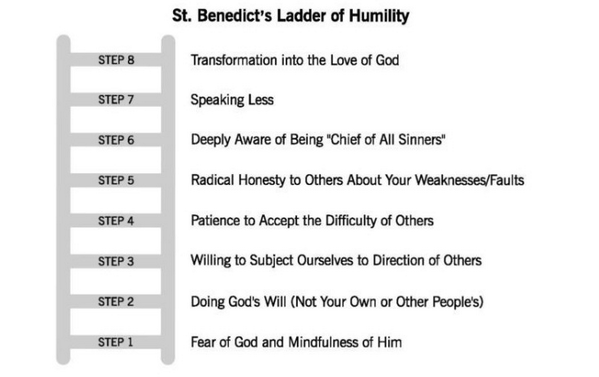
Saint Benedict, a monk from the sixth century, created a “Ladder of Humility”. I want to invite you to join me over the next several days as we study the different levels of humility. In each post, we will break down each step and look at the practical implications it has for us today.

ladderofhumility


Step 1: Fear of God and Mindfulness of Him

Tragically, we have a tendency to forget that God is in our midst. This is evident in the first book of the Bible – Genesis – When Adam and Eve attempt to play hide-and-seek with the God of the universe. It is far more comfortable to laugh at their futile attempts to hide from God; it is far less comfortable to examine our own lives and see the many ways we conceal ourselves from Him.

The first step to humility and spiritual growth is a renewed understanding that God is ALWAYS in our midst.

Not only do we need to be mindful of him but we must have a healthy fear of who He is. The writer of Hebrews says, “It is a fearful thing to fall into the hands of the Living God.” (Hebrews 10:31) Yes, we do serve an all-loving God but for love to be pure, there must be judgment. We do not define God by our ignorant definition of love; we define love by who God has revealed himself to be.

God looks upon sin with anger and disgust and promises to eradicate it from existence (which includes eternal damnation for those who live in unrepentant sin).

Practically, how do we go about cultivating this first step of humility? Here is one practical application you can begin today:

Set apart time every day to meditate, pray, and study the Word of God.

It is not possible to stress the sheer importance of this single discipline enough. First of all, allowing yourself time to rest and soak in God’s presence will enable you to be sensitive to his voice and presence the rest of the day. I highly recommend this as part of your morning routine, it will center you on the purposes and plans God has for you before you begin your work day.

If you have never spent time in prayer and study, it can be intimidating. I cannot urge you enough to watch this series of teachings by David Platt – Secret Church: How To Study The Bible – Yes, I know they are long but remember Jesus’ admonition:

“To those who listen to my teaching, more understanding will be given, and they will have an abundance of knowledge. But for those who are not listening, even what little understanding they have will be taken away from them.” (Matt. 13:12)

A second reason this is important is because it is impossible to think much of yourself in light of the Eternal God. After pondering on the greatness and grandeur of God, you will say with the Psalmist, “What is man that You are mindful of him?” (Psalm 8:4) Each day, the key to walking in humility is realizing that you are not God. You need to embrace your limitations and weaknesses and rest in the Alpha and Omega – The Unchanging One – Who will strengthen and sustain you in your life’s journey.

Your life is far too short to approach God recklessly and forgetfully. Friends, fear God and be mindful of Him this week.


What do YOU think of the ladder of humility? Do you agree with Saint Benedict? Would you add something? Leave a comment and let me know!

Go here to read Part 2: The Ladder of Humility (Part Two)

Three Books YOU Should Read

booksforblog

I love to talk about books (I’m a pastor and I work in a library, what can you expect?) At many of the staff meetings of The Rescue Church, I ask my staff what they are reading. I have learned through great men and women that Leaders ARE Readers!

I want to share with you three books that I am currently reading. I HIGHLY recommend each one of them:

Emotionally Healthy Spirituality by Peter Scazzero

I discovered this book roughly a month ago. I have been meeting with a pastor to be mentored in regards to ministry. I asked him for a list of books that he would recommend. Out of this list, I had him narrow it down to one that had impacted him the most. This is that book.

The tagline of this book is, “It’s impossible to be spiritually mature while remaining emotionally immature.” Scazzero lays out the symptoms of “emotionally UNhealthy spirituality” and offers a remedy. Specifically, he shares his own experience of: avoiding conflict in the name of Christianity; ignoring his anger, sadness, and fear; using God to run from God; and living without boundaries.

There was even a point in Peter’s ministry that his wife quit his church because she did not trust his leadership. Whether you are in ministry or not, you NEED to read this book because ALL of us are emotionally unhealthy in varying degrees.

Celebration of Discipline by Richard J. Foster

This book is a modern classic, originally published in 1978. When it comes to disciplines, celebration is usually not a word we would use to describe them. Foster writes about a variety of classic Christian disciplines that have been practiced for centuries by believers seeking to be transformed by God’s Word and Spirit.

To give you a snapshot of this book, here is a quick summary:

“Dividing the Disciplines into three movements of the spirit, Foster shows how each movement contributes to a balanced spiritual life. The inward Disciplines of meditation, prayer, fasting, and study offer avenues for personal examination and change. The outward Disciplines of simplicity, solitude, submission, and service prepare us to help make the world a better place. The corporate Disciplines of confession, worship, guidance, and celebration bring us nearer to one another and to God.”

I promise that you will be challenged, convicted, encouraged, and transformed if you study this book with a humble and teachable spirit!

My Utmost for His Highest by Oswald Chambers

Hands down, this is the best devotional I have used. Chambers was born in 1874 and died in 1917. The fact that this book is still extremely popular is a testimony to the timeless truths that Chambers shares. As a devotional, the book is divided up by dates with short readings for each day of the year. Every morning, you will find my Bible, a highlighter, and this book on my desk.

By reading this book side-by-side with Scripture, you will be encouraged to fix your eyes on Jesus Christ, kill indwelling sin, and love people with profound compassion. If you have never used this book as a devotional, or even if you have, READ it!


Now I want to ask you the same question I ask those on my staff: What books are YOU reading? What should I read next? Leave a comment and let me know!

No Ordinary Man

The-Story1
Hi everyone! I had the honor of teaching the Bible this past Sunday at The Rescue Church. We are currently going through a series called “The Story” and are taking an adventure through the entire Bible.

I taught on Chapter 24 – No Ordinary Man – and it was one of the favorite messages I have done so I wanted to share it with you!

Below are the notes.

The Story – Part 24
“No Ordinary Man”

  • Jesus is a Teacher. (Mark 4:1)
  • Jesus is a Healer. (Matthew 14:36)
  • Jesus is a Provider. (Matthew 6:25-34; Mark 4:35-40)
  • Jesus is THE Lord. (John 6:29; John 6:66)


How does this apply to my life?

Jesus is a Teacher… Are YOU listening?

Jesus is a Healer… Are YOU believing?

Jesus is a Provider… Are YOU trusting?

Jesus is the Lord… Are YOU submitting?


Did you enjoy the message? Be sure to leave a comment and share it with your friends on Facebook and Twitter!

Small Town, Big Church (Rural Ministry!)

ruralministry

Being in ministry can definitely be tough at times.

Pastors NEED encouragement and teaching. Something that I have noticed in the Evangelical world is that the vast majority of teaching geared towards pastors has a focus from a Mega-church perspective – which definitely makes sense. If you are the pastor of a church with 2,000+ people, you are going to have a much larger platform than a pastor of a 100-person church.

Don’t get me wrong, mega-churches are not evil and small churches are not automatically holy.

I pastor a campus of The Rescue Church and our vision is to plant healthy church campuses in small communities. I am a pastor in a town of about 1,200 people and I am always searching for solid resources that apply to rural ministry.

I want to invite you to check out Pastor Jon Sander’s podcast “Small Town Big Church”. Jon is the senior pastor (and founding pastor) of The Rescue Church and I have the honor of working alongside him. He has 10+ years of experience in rural ministry and I believe this podcast would be extremely helpful; ESPECIALLY if you are a pastor or church leader in a rural setting.

Check it out here!