I guess I’m a pastor again (sort of)

Uh… how did this happen?

I left pastoral ministry years ago. I was burnt out, my faith was deeply scarred, and I considered leaving Christianity. The boiling point was a simple request at the height of the COVID-19 Pandemic – I asked people in my church to please wear a mask out of consideration for those among us who were scared to attend church due to COVID.

After faithfully teaching the Bible and sacrificing my time and personal health to serve people for 10 years – I was accused of being a “liberal”, a “pharisee”, a “false teacher” – heck, one person even sent me a YouTube video on how me encouraging people to wear masks was a promotion of the “Mark of the Beast” from the Book of Revelation.

By the grace of God, I did not leave Christianity and I did not leave the church. I don’t think we even missed one Sunday, we quickly got plugged into a local church where I serve as the Vice President of the board, help lead children’s church, and preach occasionally.

So what now?

I have said repeatedly I never want to be a pastor again. Making $30k/year to be on call 24-7 and to deal with adults who act like toddlers – isn’t worth it to me. I have immense respect for pastors who continue to serve the church. It is an incredibly difficult and low-paying job.

I watched Alex Pretti be disarmed and then shot by federal agents. I then watched the US government spread propaganda at worst and misinformation at best. He was referred to as a terrorist with a mission to massacre law enforcement. Even commentators like Ben Shapiro, who is VERY conservative, called out the misinformation (this isn’t a right v left thing).

I have watched the church fall prey to the false gospel of Christian Nationalism and “America First” since Donald Trump was first elected in 2016. In 2017, I was preaching through the Book of Galatians and preached a message titled “MAGA is a False Gospel” – in rural South Dakota (you can guess how well that went over…)

What is Christian Nationalism?

I should probably define my terms. What actually is “Christian Nationalism” that I have been calling out? This isn’t about loving your country. I love this country. I am grateful to live here. Patriotism is a natural affection for your home; it’s healthy.

Christian Nationalism is something else entirely. It is a syncretistic religion that wraps the Cross in the Flag and demands you bow to both.

At its core, Christian Nationalism is the belief that America is God’s chosen nation – a “New Israel” – and that the primary goal of the Church is not to spread the Gospel of Jesus, but to seize political power to preserve a specific cultural identity. It is a framework that says to be a “true” American, you must be a Christian, and to be a “true” Christian, you must vote for a specific type of politics.

It is a false gospel because it swaps the Kingdom of God for an earthly empire.

  • Jesus taught us to love our enemies, bless those who persecute us, and lay down our rights for others (like wearing a mask to protect the vulnerable). Christian Nationalism teaches us to fear our neighbors, arm ourselves against “them,” and fight to maintain our dominance.
  • The Jesus I preached for ten years washed feet and died on a Roman cross. Christian Nationalism seeks to take over Rome. It operates on fear (fear of losing status, fear of demographic change, fear of “the left”) and fear is the opposite of faith.
  • When we equate the success of the United States with the will of God, we have stepped into idolatry. The Church existed long before America, and it will exist long after America is dust.

When people in my former congregation called me a “false teacher” for caring about public health, they weren’t defending the Bible. They were defending their political identity. That is the fruit of Christian Nationalism: it convinces good people that political allegiance is the ultimate test of spiritual faithfulness. It is a poison in our churches, and it is starving the Church of its true power.

Where are the pastors?

So… where are the pastors? A few have had the courage to call this out. One of the most notable is John Piper in his article – “My Kingdom Is Not of This World“. The majority of pastors I know agree with me that Christian Nationalism is a distortion of the Gospel, but recognize if they call it out with clarity it will lead to them being fired from their jobs (or losing half their congregation).

I don’t have a congregation, and to be blunt, I’m okay offending you and being unpopular. Jesus once said it this way, “Woe to you when everyone speaks well of you, for that is how their ancestors treated the false prophets.” (Luke 6:26).

I do not need or want financial donations. I am not limited by what I can say, based on the “large givers” I might upset. There is incredible freedom and the ability to speak with a prophetic voice in my season of life.

What is next?

I will be live streaming every Sunday at 8pm CST on Facebook and YouTube. My goal is to re-introduce people to the Jesus of the Bible by teaching verse-by-verse through the Gospel of John. We will spend 30 minutes looking at Scripture, and then I’ll take another 30 minutes to do Q&A.

This isn’t a political stream, and I am sure I will equally offend conservatives and progressives… which is a good thing.

Even if you disagree with me, I sincerely want to invite you to join me.

I hope to see you there.
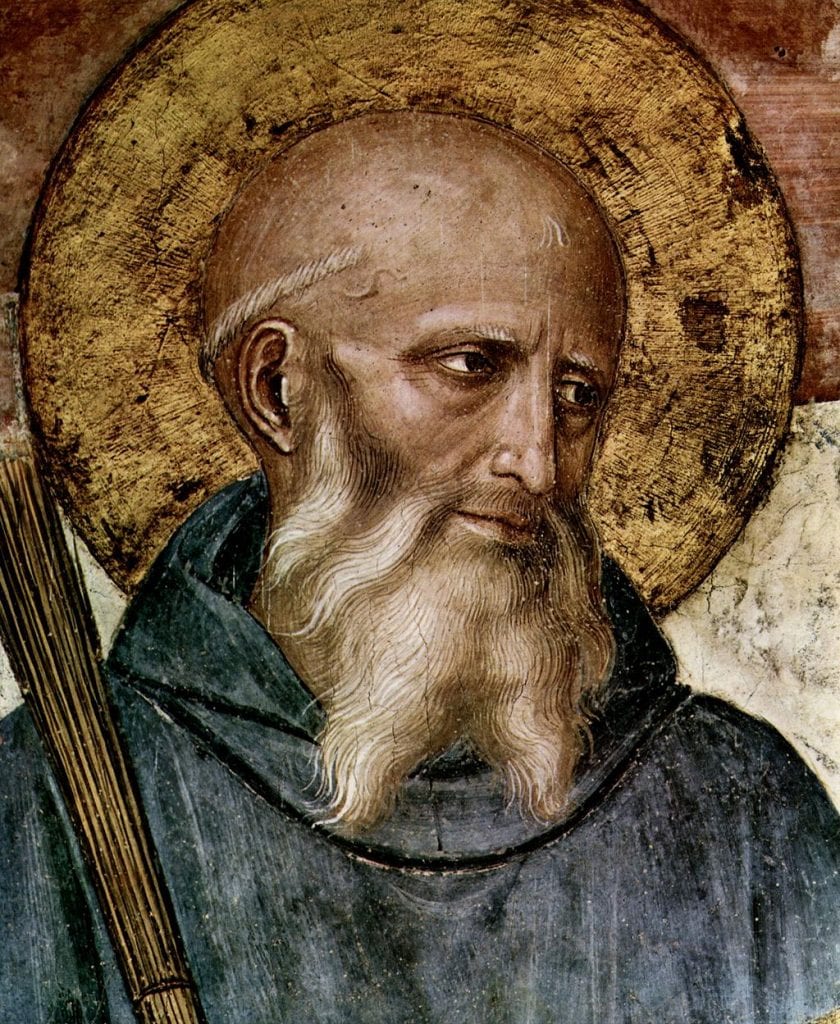
From Affluence to Monasticism – The Story of St. Benedict

stbenedict

In my previous post, I briefly outlined the project I will be working on for my Doctor of Ministry at Sioux Falls Seminary. This project is rooted in a deep and practical study of an ancient rule known as “The Rule of St. Benedict.” In this post, I will provide a little more information on the author behind this ancient monastic rule. 


Monasticism become a popular movement around the time that Constantine declared Christianity to be the favored (and then legal) religion of Rome in the 4th century. The Church went from being a persecuted minority, depending on one another and the Holy Spirit for community life, to a powerful majority as a state religion. As a result of this change, the faith slowly become corrupt. Church leaders began making extravagant amounts of money and yielding extraordinary power over those in their charge. It became the opposite of how Jesus taught his followers to exercise leadership:

Matthew 20:25-28
25 Jesus called them over and said, “You know that the rulers of the Gentiles lord it over them, and those in high positions act as tyrants over them. 26 It must not be like that among you. On the contrary, whoever wants to become great among you must be your servant, 27 and whoever wants to be first among you must be your slave; 28 just as the Son of Man did not come to be served, but to serve, and to give his life as a ransom for many.”

Many Christians were deeply pessimistic about the corrupt nature of the church. In order to live out the radical elements of the Christian faith, many retreated to the desert to be alone with God, study God’s Word, and commit to intercessory prayer on behalf of the Church.

It was in this climate (during the 6th century) that Benedict was born into an affluent family in Rome. From the little we know, Benedict lived a charmed life and had all the comforts of luxury. As he got older and was studying in the great city of Rome, he became disillusioned with his wealth and the state of the church. It was during this time of seeking that he felt drawn to monasticism.

Benedict retreated into the desert and pursued the life of a hermit. A hermit was a monk who lived on his own in an effort to seek God through prayer, Scripture study, and manual labor. Benedict’s fame began to grow and a large multitude of people were regularly visiting him to receive his counsel and insight into the spiritual life. Eventually, other men decided to apprentice themselves to Benedict and become his fellow monks. Benedict’s first foray into forming a monastery ended up as a failure; his disciplines were too strict and demanding for those who sought to follow him.

Eventually, Benedict formed another monastery at Monte Cassino around 529 (about 80 miles southeast of Rome). It was from within this monastery that Benedict developed what has come to be known as “The Rule of St. Benedict.” It was written with the purpose of applying the Gospel to the everyday lives of those in his monastic community. Nevertheless, since it was a faithful exposition of the Scriptures for community life, it became the standard monastic rule of the Western church. The fact that there are Benedictine communities all over the world, 1,500 years after the writing of the Rule, demonstrates the power of this ancient rule for our lives today.


In my next post, I will briefly outline the Rule of St. Benedict and explain how you can study it for yourself to experience the benefits of this ancient document.

Forged in Fire: Suffering & Christianity

forged-in-fire-hero-2

I’m not a big fan of television. I don’t have moral reasons against it, I just find it horribly boring most of the time. There are two shows that I will watch when they are on: The Walking Dead (of course) and Forged in Fire.

Forged in Fire is a contest show that awards money to the person who has forged the strongest blade. Many people view bladesmiths as an ancient career of the past but these men & women are beyond impressive with their craft! The finalists are given the task of re-creating a famous weapon from history. Each of them returns to their workshops, labors over the intricate details of their blades, and then returns to the show to have the blade tested.

Each person’s blade appears beautiful and well-crafted. The blades are tested through a series of stress tests. Each test is intense and has the power to shatter the blade and expose the blades imperfections. Every blade looks beautiful until it is under the scrutiny of pressure.

Might I suggest this is a perfect illustration of the Christian faith?

Peter, one of the leaders in the early church, describes the Christian faith this way:
You rejoice in this, even though now for a short time, if necessary, you suffer grief in various trials so that the proven character of your faith—more valuable than gold which, though perishable, is refined by fire—may result in praise, glory, and honor at the revelation of Jesus Christ. (1 Peter 1:6-7) 

Suffering, trials, and conflict reveal the true condition of our faith. If we are not deeply rooted in the Scriptures, committed to authentic community, and living by the power of the Holy Spirit we will not be able to endure these “stress tests.”


Are you going through a trial right now? What are you learning from God as a result? Let me know by leaving a comment, I’d love to hear from you! 

Listen… Worship… Live (Part 3)

mask

In my sermon this past Sunday I closed with three words: Listen, Worship, Live. This week I will be taking time to write an individual post for each one of these disciplines to help you apply the Bible to your life.
Listen… Worship… Live (Part 1)

Listen… Worship… Live (Part 2)


When I was 16 years old I was arrested for drug possession and drug paraphernalia. Leading up to my arrest, I was writing and performing Christian music as well as speaking to youth groups about the Gospel. I literally got arrested one week after performing a song in a church that warned against the dangers of drug use!

In other words – I was a hypocrite.

My lifestyle did not match my confession of faith. Unfortunately this is far too common in our churches. Many of us confess that Jesus is Lord on Sunday but live as if He does not exist Monday through Saturday. We only follow the teachings of Jesus when it’s convenient for us.

This is not a modern problem. James, one of the leaders in the early church, exhorted people with the following instruction:

James 1:22-25
22 But be doers of the word and not hearers only, deceiving yourselves. 23 Because if anyone is a hearer of the word and not a doer, he is like someone looking at his own face in a mirror. 24 For he looks at himself, goes away, and immediately forgets what kind of person he was. 25 But the one who looks intently into the perfect law of freedom and perseveres in it, and is not a forgetful hearer but a doer who works—this person will be blessed in what he does.

Pay special attention to verse 25 (I have underlined it). James does not say that the one who looks intently at behavior modification will then be a “doer who works.” Rather, it is the one who looks intently into the “perfect law of freedom.” He is speaking about the Scriptures – the 66 books of the Old Testament and New Testament that God uses to encourage, correct, rebuke, and train His people for righteousness.

What steps can we take to make sure our lives match our confessions? How do we truly LIVE as followers of Christ?

1. Look intently at the Scriptures.
What James is describing is a far deeper reading of the Bible than we generally practice. For most of us, we spend a few minutes each day reading a passage or a chapter from the Bible. At the most, we spend a few minutes reflecting on the passage and considering its application for our lives. This is good – do not misunderstand me – but it is not enough to sustain us.

One good way to do this is to study a new book of the Bible every month. Read commentaries on the book, study the historical context, read/listen to sermons preached from the book. If you are part of Renovation Church, I encourage you to study the Gospel of John deeply. We are walking through it verse-by-verse on Sunday mornings so it would be a great way to “look intently” at the Scriptures!

2. Takes notes when you read the Bible!
James describes two kinds of people who read the Bible – the first is a “forgetful hearer” and the second is a “doer who works.” Friends, we are far too guilty of being forgetful hearers! We study a passage in the morning and by lunch time we cannot even recall what we read a few hours before.

The best way to transition from forgetfulness to memory is to write down what you learn in your Bible reading. I utilize the CSB Notetaking Bible. This is a special Bible that has large margins for the reader to take notes and write prayers. After studying a passage I try to respond to what God is saying by writing out my prayer to Him in this Bible. Another added benefit is I hope to give this Bible as a gift to Ava when she graduates high school. It will (Lord Willing) be marked up by personal prayer and reflections of mine from my daily Bible reading!

3. Rely on the power of the Holy Spirit.
This third point does not come from the text above but is a major theme throughout all of the Scriptures. When Jesus ascended to be with the Father, he sent the Holy Spirit to fill His people. He promised that “the Advocate, the Holy Spirit, whom the Father will send in my name, will teach you all things and will remind you of everything I have said to you (John 14:26).”

Please understand that you cannot make this transition through sheer will power. The ability to live out the Scriptures is a supernatural gift – it is the result of the Holy Spirit leading you daily to the River of Life. We should continually be pleading with the Holy Spirit to fill us so that we might treasure Christ over the meaningless distractions of this world.

If you are interested in learning more about studying the Bible in an effective way, I recommend the following book:
Reading The Bible Supernaturally – John Piper 

Listen. Worship. Live.

If you have found these blog posts helpful, I’d love to hear from you. Leave a comment or send me an e-mail (tyler@renovationchurchsd.com)


Listen… Worship… Live (Part 2)

pexels-photo-132037

In my sermon this past Sunday I closed with three words: Listen, Worship, Live. This week I will be taking time to write an individual post for each one of these disciplines to help you apply the Bible to your life.
Listen… Worship… Live (Part 1)


We often associate “worship” with a particular music style. This has caused the church to shrink the magnitude of worship. By this definition, worship is something we do once a week when we gather with other Christians to sing a few songs. Singing IS a form of worship but it is only a tiny part of true worship.

One of the greatest theologians of the church, the Apostle Paul, described worship this way in Romans 12:1 – Therefore, I urge you, brothers and sisters, in view of God’s mercy, to offer your bodies as a living sacrifice, holy and pleasing to God–this is your true and proper worship.

1. Worship is our response to God’s mercy.
Paul is urging the believers in Rome to offer their bodies as a living sacrifice IN VIEW of God’s mercy. Worship is how we respond to God’s initiative in our lives. In my previous blog post, I challenged you to set aside time to intentionally listen to God. Listening is required for worship – for worship is a response to our listening.

One of the best ways to do this is by practicing “lectio divina.” This is an ancient practice that literally means “divine reading.” It is the process of slowly reading and praying through the Scriptures. It transforms Bible reading from being a quest for information to a journey towards transformation. It allows Scripture reading to become a dialogue rather than a monologue.

You practice lectio divina by allowing the Scriptures to invite you into a conversation with God. You pray the prayers you find in the Bible, you thank God for his promises, and you meditate on His acts of faithfulness in your life.

2. Worship involves the totality of who you are.
Paul defines “true and proper worship” as offering our “bodies as a living sacrifice, holy and pleasing to God.” Worship is both a physical and a spiritual act. I have personally found it helpful to kneel on the ground when approaching God in prayer. This is an act of my body that helps my spirit remember that God is the Sovereign One of the universe. In comparison to God, I am but a mist that is here today and gone tomorrow. God is from everlasting to everlasting.

True worship engages our intellect and emotions… our minds and our hearts… our bodies and our spirits. Our theology (study of God) should always lead to doxology (the worship of God). Ultimately, worship is our response to God’s act of sending the Lord Jesus Christ to live a perfect life, die an atoning death, and resurrect from the grave for the redemption of the world.

So what does this actually mean? What does it look like for each of us to live a life of worship? 

First, it begins by listening to what God is saying. This is done by spending daily time in Scripture reading, silence, and solitude. After reading the Scriptures, spend a few minutes thanking God for what He has spoken to you. A helpful way to do this is by writing out a prayer of response. This can be extremely beneficial because your writings will provide you with a monument of your time with God. These prayers are moments with God that you can return to regularly to be reminded of His faithfulness.

All of life is worship. Your work, your family, your “free time” – all of it belongs to God. Is Jesus the Center and Sustainer of all that you do? Or are you ascribing worship to yourself rather than God? 


Listen… Worship… Live… (Part 1)

listenIn my sermon this past Sunday I closed with three words: Listen, Worship, Live. This week I will be taking time to write an individual post for each one of these disciplines to help you apply the Bible to your life. 


Most days I feel as if I am drowning in sound. The constant barrage from the television… the never-ending statuses on Facebook… and the persistent buzzing of my cell phone threaten to cause death by distraction.

We are polluted with messages from our culture. Messages which instruct us on living a better life, purchasing a new product, or even experiencing a special church service. These messages darken our minds and distract us from the One who really matters.

God is far more willing to speak than we are to listen.

Are you intentionally setting aside time on a daily basis for solitude, silence, and listening? I want to challenge you to practice this ancient art of listening to God speak every day for one week. The specifics are below:

Set aside a 30 minute block of time each day this week. Maybe you need to wake up 30 minutes earlier… utilize a portion of your lunch break… or stay up after putting the kids to bed. I want you to structure these 30 minutes in the following way:

  1. Spend time in complete silence (2 minutes).
  2. Slowly read through a passage of Scripture (20 minutes).
  3. Choose one or two verses from your reading and commit them to memory (5 minutes).
  4. Spend some more time in complete silence as a response to God’s Word (3 minutes).

If you take this challenge seriously you will be amazed at the spiritual growth that results. To make this as simple as possible, I would encourage the following reading plan this week. It will allow you to read the entire book of Galatians in the New Testament:

Monday: Galatians 1
Tuesday: Galatians 2
Wednesday: Galatians 3
Thursday: Galatians 4
Friday: Galatians 5
Saturday: Galatians 6


If you decide to take this challenge, I would love to hear from you. Either leave a comment or send me an e-mail (tyler@renovationchurchsd.com)

Three Ways to Prevent Burnout

StockSnap_GYKA6CP3QO

This is the sixth post in a series of reflections based on Jared Wilson’s book “The Pastor’s Justification.”


Beautiful explosions filled the sky this past week as people around the United States celebrated Independence Day. One of the evenings when Ava (my almost 8 month old daughter) wasn’t able to sleep, we gazed out the window at these spectacular displays of firepower. The deep canon-like sound filled the room as small canisters burst and illuminated the darkness only to recede into debris.

These fireworks – beautiful displays of power which dissipate in seconds – are sadly a picture of pastoral ministry.

Jared Wilson, in his book The Pastors Justification, says it this way, “Flashy things tend to burn out quickly. And as many have learned, extraordinary gifts can take a man where paltry character cannot keep him.

Flashy ministry begins as a beautiful light that illuminates the darkness but decays into debris that litters the ground.

How can church leaders – pastors especially – prevent themselves from burning out quickly in the pilgrimage of ministry?

1. Meet with God.
This seems to be an obvious starting point but one that ministers neglect far too often. There are a multitude of pastors that only spend time in the Bible when preparing a sermon or Bible Study. This removes the demands of Scripture from the personal life of the pastor and only places them on the congregants.

Pastor – you cannot lead people to where you have not been yourself.

Each message must be immersed in the presence and power of God. We must discipline our schedules to prioritize time with God above every other demand. We are not CEOs leading small companies; we are mystics inviting people to experience the Living God.

2. Love Your Family.
Your identity is not rooted in your ministry activity – it is rooted in Jesus. Your family is the primary ministry God has given you; not your church. If you are sacrificing your family on the altar of ministry it is only a matter of time until you implode from the effects of your idolatry.

Guard your time. Recognize that most demands are not emergencies and do not require you to immediately leave your family. Be present; quit staring at your stupid smart phone each time you hear the ping of a notification.

3. Discover the Sacred in the Ordinary. 
To say the least, ministry is demanding. We rush from one meeting to the next, striving to offer counsel and comfort to those afflicted by deep distress. Margin is stripped away in the face of the urgent.

Friends, we need to slow down.

God is revealing himself through the beauty of nature, the face of a loved one, and the laugh of a child. My daughter Ava has shown me the power of wonder. She is amazed at everything – from the texture of food to petting a cat! If we are going to strive in ministry we need to ask God to restore the wonder we have lost by slowing down and being present in the theater of creation.


What advice would you offer to a church leader to prevent burn out? Let me know by leaving a comment!

The Experience of Pruning…

weinberg merzhausen

I spent a few hours this past Saturday in the beautiful vineyard of Tucker’s Walk just outside of Garretson. One of the owners of Tucker’s Walk – Dave Greenlee – explained to me the process of pruning the vines for greater fruitfulness. It was memorizing as he skillfully slashed off dead branches and carefully secured the stock to the metal fence to keep it properly aligned.

Intentionally slicing these branches seemed to be a cruel process… but it is vital for the growth of the plant. Dave explained that the goal is to remove 90% of the plant’s growth from the previous season for high-quality grapes.

Ninety percent is a large portion of the vine!

Jesus spoke about this same reality in our own lives. After spending time watching a professional skillfully cut and mend the vineyard, Jesus’ words have become a greater reality to me:

“I am the true vine, and my Father is the gardener. He cuts off every branch in me that bears no fruit, while every branch that does bear fruit he prunes so that it will be even more fruitful.” (John 15:1-2)

When we experience the tender hands of our Heavenly Father removing unhealthy patterns in our lives, it can cause excruciating pain. There are seasons that we flood our beds with tears and can only produce groans in our prayers. We scream out for comfort but it seems as if our very identity has been forcefully removed.

Take heart… Christians that bear fruit experience pruning in order to bring about greater health. It seems brutal; even unloving at times. The Master Gardener – the God who sent his Son for our salvation – prunes with great patience and love for the souls of His people.

Are you going through a season of pruning? What has God been calling you to let go of? Are you listening or has the pain blinded you to the love of the Father?

I Meet With a Therapist.

bible

I am utterly weak and unqualified to be a pastor.

My leadership is ruled more by timidity than boldness. My actions often derive from a desire to please people rather than God. The motivation behind my preaching springs from a desire for the praise of man rather than the affirmations of the Father… far more than I’d like to admit.

I stress the need for community while drowning in isolation. I proclaim the importance of confession while remaining silent about my own sin. Each Sunday, I exhort people with the message that God loves broken people… while practically denying the same message for my own life.

In short, I am broken.

In my own mind, sin is often a greater delicacy than the glory of God. I sink my teeth into this disgusting, mold-covered appetizer while believing the lie that it offers a greater freedom than obedience to Jesus.

I shared some of these realities with my church recently. I’ve always thought only weak, needy, and emotionally sick people need to see a professional counselor on a regular basis.

I still believe this.

I just realized that I also fall into this category.

I have started meeting with a professional Christian therapist at Sioux Falls Psychological Services in order to pursue Christ-centered wholeness. I debated whether or not to share this with people because it would reveal the illusion of my perfection. It was into this internal argument that the Holy Spirit resounded the paradoxical words of the Apostle Paul:

But he said to me, “My grace is sufficient for you, for my power is made perfect in weakness.” Therefore I will boast all the more gladly about my weaknesses, so that Christ’s power may rest on me. – 2 Corinthians 12:9

I don’t have all the answers. People come to me on a regular basis expecting counseling… not realizing that I am utterly aware of how inadequate I am to provide it for them.

Pastor – the Gospel you proclaim is for you.

Our identity isn’t found in the mask of perfection we wear on Sundays. Our righteousness doesn’t flow from the weekly attendance or yearly budget at our churches. Jesus – the only Perfect One to ever live – willingly subjected Himself to brutal torture and crucifixion for the wrath that we justly deserve. This same Jesus resurrected from the grave – offering eternal life, forgiveness, and a foreign righteousness to all who come to Him by faith.

Jesus lived the perfect life we could not live… died the death we deserve to die… and rose from the dead for our justification.

There is a Great Physician that skillfully applies healing salve to the wounds of his people – even pastors. It’s okay to not be okay. 

Our World is Falling Apart.

fallingapart

Young children experiencing excruciating abuse & humiliation as victims of sex trafficking.

Babies have bodies destroyed by the viciousness of cancer.

Men & women squeeze the cold steel of a handgun while pointed it at themselves; intent on escaping the cruelty of this world through suicide.

Many are in bondage to addiction – drugs, alcohol, pornography – and are powerless to overcome the chains which choke life out of their souls.

Each of us has experienced the utter darkness of this world. For every moment of joy, there are numerous incidents of earth-shattering pain. We cry out for redemption but it seems to be a distant reality; we scream to God for healing but our bodies continue to decay.

The world we live in is marked by suffering, corruption, and brokenness. It has been this way since the first humans chose to willfully disobey God. Their rebellion unleashed the power of death to reign over all of creation.

It is into this wicked and sin-sick world that God became a man.

The Incarnation. Emmanuel. God with us.

Jesus.

“This is the verdict: Light has come into the world, but people loved darkness instead of light because their deeds were evil…” – John 3:19

Today marks the first Sunday of Advent. It in this season that we return our focus to the One who really matters – Jesus Christ. He is the only One who gives hope to this world. I want to encourage you to spend intentional time over the next few weeks considering the incredible reality of the Gospel.

Jesus lived the life we could not live; died the death we deserve to die; and resurrected from the dead VICTORIOUS over the world, Satan, and our flesh.

In the midst of the hopelessness which rules in our culture, Jesus is the embodiment of Hope.

“In this world you will have trouble. But take heart! I have overcome the world…” – John 16:33