From Affluence to Monasticism – The Story of St. Benedict

stbenedict

In my previous post, I briefly outlined the project I will be working on for my Doctor of Ministry at Sioux Falls Seminary. This project is rooted in a deep and practical study of an ancient rule known as “The Rule of St. Benedict.” In this post, I will provide a little more information on the author behind this ancient monastic rule. 


Monasticism become a popular movement around the time that Constantine declared Christianity to be the favored (and then legal) religion of Rome in the 4th century. The Church went from being a persecuted minority, depending on one another and the Holy Spirit for community life, to a powerful majority as a state religion. As a result of this change, the faith slowly become corrupt. Church leaders began making extravagant amounts of money and yielding extraordinary power over those in their charge. It became the opposite of how Jesus taught his followers to exercise leadership:

Matthew 20:25-28
25 Jesus called them over and said, “You know that the rulers of the Gentiles lord it over them, and those in high positions act as tyrants over them. 26 It must not be like that among you. On the contrary, whoever wants to become great among you must be your servant, 27 and whoever wants to be first among you must be your slave; 28 just as the Son of Man did not come to be served, but to serve, and to give his life as a ransom for many.”

Many Christians were deeply pessimistic about the corrupt nature of the church. In order to live out the radical elements of the Christian faith, many retreated to the desert to be alone with God, study God’s Word, and commit to intercessory prayer on behalf of the Church.

It was in this climate (during the 6th century) that Benedict was born into an affluent family in Rome. From the little we know, Benedict lived a charmed life and had all the comforts of luxury. As he got older and was studying in the great city of Rome, he became disillusioned with his wealth and the state of the church. It was during this time of seeking that he felt drawn to monasticism.

Benedict retreated into the desert and pursued the life of a hermit. A hermit was a monk who lived on his own in an effort to seek God through prayer, Scripture study, and manual labor. Benedict’s fame began to grow and a large multitude of people were regularly visiting him to receive his counsel and insight into the spiritual life. Eventually, other men decided to apprentice themselves to Benedict and become his fellow monks. Benedict’s first foray into forming a monastery ended up as a failure; his disciplines were too strict and demanding for those who sought to follow him.

Eventually, Benedict formed another monastery at Monte Cassino around 529 (about 80 miles southeast of Rome). It was from within this monastery that Benedict developed what has come to be known as “The Rule of St. Benedict.” It was written with the purpose of applying the Gospel to the everyday lives of those in his monastic community. Nevertheless, since it was a faithful exposition of the Scriptures for community life, it became the standard monastic rule of the Western church. The fact that there are Benedictine communities all over the world, 1,500 years after the writing of the Rule, demonstrates the power of this ancient rule for our lives today.


In my next post, I will briefly outline the Rule of St. Benedict and explain how you can study it for yourself to experience the benefits of this ancient document.


The Death of Pastoral Ministry

andy-falconer-1531630-unsplash

The majority of those who embark on the journey of pastoral ministry will end up being a statistic of burnout, depression, exhaustion, and bitterness. On average, seminary-trained pastors will last less than five years in pastoral ministry.

This is a problem. Our current philosophy of ministry is killing the pastoral office.

As many of you know, I have begun the journey of attaining my Doctor of Ministry through Sioux Falls Seminary and I am hoping to address this problem. A few years ago I was on the verge of becoming another statistic; I was becoming pessimistic about ministry and drinking the poison of bitterness. It was during this painful season that a mentor of mine invited me on a 3-day retreat to a Benedictine Monastery known as St. John’s Abbey in Collegeville, Minnesota.

As a good, nondenominational pastor, I was not a fan of liturgy or the Roman Catholic Church. I assumed that liturgy (i.e. written prayers) were inauthentic and aligned with the babbling Jesus warned against in the Lord’s Prayer. Regarding the Roman Catholic Church, I followed the lead of Martin Luther and assumed the Pope was the Anti-Christ and the Roman Catholic Church was the Babylon spoken about in the Book of Revelation.

Nevertheless, I was desperate.

Desperate for a spirituality that was deeper than a surface reading of a text with vague applications.

Desperate for way of measuring success that went deeper than attendance and budget numbers.

Desperate to truly experience the ancient God of the Bible rather than the false american god many of us worship in our churches.

Desperate to align my ministry with the trusted traditions of the church rather than sleek business models that propagate the false gospel of marketing and excellence.

With the Psalmist, I realized my soul was panting for God like a deer pants for streams of water (Psalm 42:1). The wells of evangelicalism and popular church culture had run dry. I was discouraged by attendance numbers, giving statistics, and my lack of “success” as defined by modern evangelicalism.

That 3-day retreat was a turning point in my faith and leadership. I participated in the Daily Office with the monks – gathering throughout the day to chant the Psalms and listen intently to the reading of Scripture. I began to read a small book placed in the guest room called “The Rule of St. Benedict.” This is an ancient monastic rule written by Benedict of Nursia in the 6th century.

It is no exaggeration to say that the Holy Spirit used this ancient monastic rule to save my ministry and renew my resolve to remain faithful as a husband, dad, and pastor. I will be spending the next 3 to 4 years studying and applying this Rule to the lives of other pastors with the hope that the Holy Spirit will breathe renewal into their lives and ministries.


This is the first post in a series – stay tuned for more discussion on the Rule of St. Benedict, my story, and how I believe this ancient rule offers a philosophy of ministry that is able to bring greater healing and depth into the ministry of pastors in small churches. 

Q: Is Jesus being the “only way” to God narrow-minded?

religions-all-e1457020969272-825x497

One of the questions people often ask me has to do with what theologians call the “exclusivity” of Jesus Christ. Christians throughout the centuries have faithfully proclaimed that Jesus’ life, death, burial, and resurrection are the only means by which humankind can be reconciled and put into a right relationship with God.

To modern ears, that sounds incredibly narrow-minded. What about all the people who grew up in different cultures with different religions – how can Christians arrogantly assume those other people are wrong simply because they do not use the same language when talking about God?

Many mainline denominations also reject the exclusivity of Christ. Instead, they view Christ as one way among many for people to be in a relationship with God. This is seen clearly in the way some mainline denominations talk about the Bible, salvation, and eternity.

So, what does Renovation Church (and by extension – I – Tyler Ramsbey) believe?

We believe and affirm the historical Christian teaching that there is no other name under heaven by which humankind can be saved (Acts 4:12).

How can we possibly hold to that narrow-minded, bigoted, and anti-Western truth?

Simple: The suffering of Jesus Christ.

Before being crucified, Jesus was brutally beaten beyond human recognition by a Roman scourge. This was a whip that would have shagged bone, piercing nails, and sharp metals attached to the ends of it. Jesus was beaten 39 times times by the Roman scourge – a beating that would cause most people to pass out from the pain. His flesh was literally ripped from his body.

After being scourged, Jesus is forced to carry His cross to a place of execution called Golgotha (lit. Place of the Skull). There he is stretched out while Roman Soldiers fasten him to the cross by hammering 6 – 9 inch nails through his wrists and his feet. He would then be hoisted up as onlookers jeered and mocked him. Crucifixion was invented by the Persians but perfected by Rome – it was such a horrifying way to die that Roman citizens could not be sentenced to crucifixion; it was a sentence reserved for foreign enemies and slaves.

Jesus endured all of this willingly. He is not a victim – He was in full control the entire time. Yet He endured the cross, drinking the full cup of God’s wrath that we deserve for our sin, in order to reconcile us back to the Father.

Friends, if it was possible to be reconciled back to God through the teachings of Buddhism, Islam, Judaism, New-age spirituality, or trying to be a “good person” – Jesus was the biggest fool and idiot for submitting himself to crucifixion. IF there was another way for humankind to be made right with God, the cross becomes divine child abuse at the hands of a sadistic deity who crushes His Son for no reason.


That’s why we believe Jesus is the only way to be made right with God. What say you? Do you disagree or agree? I’d love to hear from you in the comments! 

Today I Begin My Doctorate!

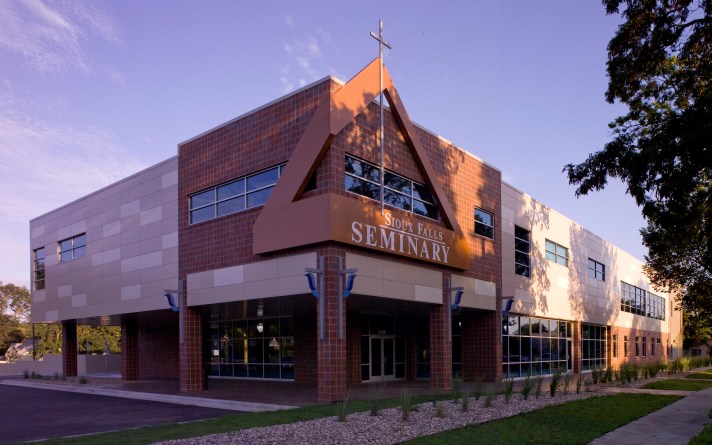
siouxfallsseminarycampus

I have recently been accepted into the Doctor of Ministry program at Sioux Falls Seminary. Those of you who have been following my blog, you know that I have also recently finished my Master of Divinity through Sioux Falls Seminary (others may be wondering if I will ever be done with school – probably not!)

To help with finances, I will also be working as a Teaching Assistant at the seminary and helping train future pastors  (which I am super excited about!). This will be in addition to my calling as the Lead Pastor of Renovation Church and the host of The Blue Light Podcast in Garretson! (I also occasionally work at Southeast Technical Institute a few days each semester to help out when it is busy).

I wrote this post to give all of you a short update on what is going on in my life. The way a doctorate program works is it is geared around a master project or a master thesis. More than likely, this will be a 100-page scholarly research paper that adds value to the Church. My research will be built around spiritual formation and church leadership – helping pastors find their identity in Christ rather than in the empty success of church attendance, church finances, or other so-called indicators of “success” in ministry.

If I could paint my “ideal” future, it would be teaching theology or spiritual formation at the college/seminary level on a part-time basis while continuing to pastor Renovation Church in Garretson.

Your prayers are much appreciated as I begin this new journey!


Are You Following the Jesus of the Bible or the Jesus of America? (New Message!)

In the message I shared this past Sunday at Renovation Church, I had the honor of teaching through the greatest failure of Peter’s life – his three denials of Jesus Christ. In a similar manner, I would argue that the vast majority of American Christians are also guilty of denying Jesus in a way that is more subtle but just as dangerous – we worship an American Jesus rather than the Jesus of the Bible.

What exactly do I mean? I invite you to get a Bible & a notebook and watch the message below!

(If you are reading this in your e-mail you will have to go to the actual page to watch the message.) 

YOU Are Invited to an Online Small Group With Me!

howtostudy

I am going to be leading a 3-week small group around the topic “How To Study the Bible” based out of material from the “Multiply” book by Francis Chan. I believe this is so important for everyone to experience that I am offering it both in-person in Garretson, SD and online via Google Hangouts.


In-Person Group:
The in-person small group will meet on the following Saturdays at 8am at O So Good in Garretson. If you live in the Garretson area, I’d be honored to have you join me.

  • Saturday, January 19th @ 8am
  • Saturday, January 26th @ 8am
  • Saturday, February 2nd @ 8am

Here’s a link to the Facebook Event for the in-person small group. 


Online Group:
The online small group will meet on the following Tuesdays at 10pm via Google Hangouts. In order to use Google Hangouts you need a Gmail account and a webcam. For questions, send me an e-mail (tyler@renovationchurchsd.com) or leave a comment.

  • Tuesday, January 15th @ 10pm
  • Tuesday, January 22nd @ 10pm
  • Tuesday, January 29th @ 10pm

Here’s a link to the Facebook Event for the online small group. 

Beware Of Wolves

wolf

One of the most difficult and terrifying roles of a pastor is to battle against wolves who seek to infiltrate the church. The Apostle Paul exhorts the elders (pastors) in Ephesus with the following, “For I know this, that after my departure savage wolves will come in among you, not sparing the flock. Also from among yourselves men will rise up, speaking perverse things, to draw away the disciples after themselves.” (Acts 20:29-30)

These “wolves” are false teachers who creep into the church and seek to mislead the people of God with false doctrine.

The short letter of Jude is a warning to all Christians – especially pastors – to “contend earnestly for the faith which was once for all delivered to the saints (Jude 1:3).” This small but powerful epistle is a grave warning that false teachers WILL seek to infiltrate our congregations and we must be on our guard against them.

In Jude 1:12-13, the Holy Spirit through Jude gives us four descriptions of these false teachers:

1. They Promise Life but Lead to Death.
Jude writes that false teachers are, “clouds without water, carried about by the winds.” This condemnation is two-fold. First, clouds in the first century often brought the promise of rain during a drought. Likewise, false teachers give the appearance of godliness, wisdom, and sound teaching but there is no true life found in their teaching. Instead of building up the Body of Christ, false teachers use flattery to build their own platforms and draw believers away from the Church.

Second, Jude’s statement that they are “carried about by the winds” means that the false teachers are driven by their own appetites and fleshly desires. They refuse to submit their teaching to the Bible or their authority to a local church; instead, they drift from church to church and are carried along by the false “spirits” of this world.

2. They Appear to be Alive but are Dead.
The second description Jude gives for these false teachers is that they are, “late autumn trees without fruit, twice dead, pulled up by the roots.” From a distance, it is difficult to discern whether a tree is alive or dead. As you get closer to the tree, it becomes apparent that it has no fruit and the root system has been removed from the ground. In the same way, from a distance, false teacher appear to be spiritually alive and worth following. Upon closer inspection, it will become apparent that the false teacher does not display the fruit of the Spirit, is spiritually dead, and has been removed from the root of Christ.

3. They Boast In Their Shame.
Third, Jude writes that these false teachers are, “raging waves of the sea, foaming up their own shame.” During a storm or a strong wind, waves create foam on the surface of the water for all to see. In the same way, false teachers boast in their shame rather than pursuing holiness. They refer to evil behaviors as good and call good behaviors evil. False teachers applaud and accept such sinful behavior as abortion, homosexual activity, sex outside of marriage, divorce, gossip, and various other sins. In the process, they confuse genuine believers and cause divisions in the church.

4. They Refuse Stability and Community.
Fourth, Jude describes these false teachers as, “wandering stars for whom is reserved the blackness of darkness forever.” Once again, this has two implications. First, as I mentioned in the first point, false teachers do not submit to church authority or commit themselves to a local church. Instead, they wander from fellowship to fellowship – often avoiding the accountability and discipline of a church body.

Second, just like a shooting star, the teaching of a false teacher is short-lived. It seems remarkable when it comes forth but under closer examination and through a length of time, it quickly dissipates. This has proven true for all of the ancient heresies throughout church history and will continue to be true for all “new” teachings. As a rule of thumb, if a person claims to have a “new” revelation from God, run as far as you can!


What are some other descriptions you would add for false teachers? I’d love to hear and learn from you. Please leave a comment and share your thoughts! 


7 Pillars of a Successful Ministry

pillars

I just finished listening to an excellent message from Kent Hughes, the author of Liberating Ministry from the Success Syndrome. According to Hughes, many pastors and ministry leaders feel like failures because they are measuring success according to the metrics of this world rather than according to Scripture. With this premise, he gives the audience seven “pillars” of a successful ministry.

Once a month I schedule a personal retreat for a full day. I use this day to reflect on the ministry God has given me and to examine how I am doing in light of His calling. My goal for these days is to repent of sin and resolve, by the power of the Holy Spirit, to conduct myself in a manner worth of the Gospel of Christ (Philippians 1:27).

My next retreat day is tomorrow so I wanted to use these pillars as a guide to ask myself some hard questions. Below are the questions I am going to wrestle with and I hope they challenge you in your own unique context:

Pillar #1: God measures success by faithfulness to His Word.
Q: In what ways have I devalued the authority of Scripture in my life and ministry?
Q: Is there a command from Scripture which I am failing to be obedient to out of fear of offending or upsetting someone in my congregation?
Q: Am I regularly studying and meditating on the Bible? 

Pillar #2: God measures success by serving Him with a foot-washing heart.
Q: In what ways do I need to repent of a domineering leadership style so that I may embrace being a servant? 
Q: Is there a duty in my personal life or ministry that I am avoiding because I feel as if it is “below me”? 
Q: What are some specific ways I can serve the Church God has placed me over as a shepherd?  

Pillar #3: God measures success by loving Him with all one’s heart and soul.
Q: Is my ministry flowing from a deep love for God or an unhealthy need for human recognition? 
Q: Is God’s love evident in the way I speak to and treat those closest to me – especially Ashley and Ava? 
Q: What changes is the Holy Spirit asking me to make to my schedule so that I can pursue my relationship with God above all else? 

Pillar #4: God measures success by believing/having faith in the God who is.
Q: In what ways have I foolishly tried to re-create God according to my image and imagination? 
Q: Is there a promise from God which I am struggling to believe? If so, what steps can I take to find help and counsel? 
Q: Do I honestly have an accurate view of God as He has been revealed in Jesus Christ? 

Pillar #5: God measures success by praying with the passion of Jesus Christ. 
Q: What demands on my time have I allowed to push away the regular discipline of prayer?
Q: What people or organization is God laying on my heart this month to spend extra time in prayer for? 
Q: What are some steps I can take to strengthen my prayer life? 

Pillar #6: God measures success by living a holy life in a pornographic world.
Q: In what ways have I allowed my mind/heart to be seduced by lust?
Q: What does regular repentance and freedom look like in the area of sexual lust?
Q: Have I been meeting regularly with (and being honest with) my accountability partner – especially in regards to lust? 

Pillar #7: God measures success by having an attitude that sees “the stars through the bars” and by rejoicing in the elevation of others.
Q: Have I been jealous of the success of other pastors and churches? If so, what is the root cause of this jealousy?
Q: How have I allowed pride to express itself in my life – both in the forms of arrogance and self-pity?
Q: How is God calling me to submit my attitude to that of Jesus as recorded in Philippians 2:1-11?


I hope these questions both challenge you and encourage you. If you are not in the habit of taking a 1-day retreat every month, you should try it. This is vital for all of us who are Christians – regardless of the vocation God has called us to. 

What The Copper Lounge Collapse Teaches Us About The Church

copper-lounge-collapse-overview

Today marks exactly two years since the horrific Copper Lounge Collapse in Sioux Falls. When this downtown building crumbled to the ground, one person died and another was trapped under the rubble. I remember watching the rescue operation as I was working at Southeast Tech and hearing the horrible news that a person died in the collapse.

After numerous investigations of why this happened, investigators learned that the contractor working on the building illegally removed a load-bearing wall without the proper training. A load-bearing wall is vital to the structure of a building and is what supports everything above it. The removal of a load-bearing wall without any replacement will eventually cause a building to collapse – which is what happened on that fateful December day in 2016.

Might I suggest this is a picture of the Christian Church – especially in the United States?

Towards the end of Jesus’ high priestly prayer, he shifts his focus from praying for the disciples to praying for all future Christians. In John 17:20, he prays to the Father, “I do not pray for these alone, but also for those who will believe in Me through their word.

Although it’s easy to miss since we have a habit of reading the Bible far too quickly, Jesus makes it clear that the key to believing in Him is through the “Apostolic” word (or the word of the Apostles).

Jesus wants us to understand that the Church is not built on our personal vision but rather on the Word He has given us through the Scriptures. As soon as a local church seeks to be built on anything other than the Bible and the person of Jesus, it will soon collapse. Sure, the numbers may increase because the messages are geared around the “felt-needs” of the audience – but the Church will fail to make disciples or help people grow spiritually.

The Apostle Paul, using a similar building analogy, describes the Church as, “having been built on the foundation of the apostles and prophets, Jesus Christ Himself being the chief cornerstone, in whom the whole building, being fitted together, grows into a holy temple in the Lord (Eph. 2:20-21).

This is one of the many reasons we preach through books of the Bible at Renovation Church rather than topical sermon series. I am convinced without faithful verse-by-verse exposition of the Bible, the Church will quickly be built on the personality and interests of the preacher rather than the “apostles and prophets” with Jesus as the “chief cornerstone.”

Here’s a question I want to challenge you with today: who or what is the foundation of your life? The church is the gathering of God’s people; in order for the Church to be built on the Bible and Jesus, each of our lives much also be built on the Bible and Jesus.

As a Christian, the foundation of our lives is NOT family, career, income, citizenship, political party, or anything else in this world. An authentically Christian life is one which is rooted in the teaching of Scripture and sustained by the person of Jesus Christ.

As we begin Advent today, what are some ways the Spirit is calling you to build your life on this firm foundation? 

Is Your Church a Swamp or a River?

swamp

This past Sunday I had the honor of teaching through John 17:6-19 at Renovation Church. This is the most powerful, beautiful, and magnificent prayers ever recorded in human history for it is prayed by God Himself – the Lord Jesus Christ.

The last question I challenged my congregation to consider was this:

Q: Am I Mission-Focused or Inward-Focused?

This question flows out of what Jesus says in John 17:18 – “As you sent me into the world, I also have sent them into the world.”

As Christians, we are called to be “sent ones.” We are sent by Jesus into our homes, workplaces, and communities in order to share the message of John 3:16 with every possible person.

I want you to think of two bodies of water: a swamp and a river.

“Swamp” Christianity:
A swamp is created when a body of water remains stagnant. Since there is no fresh water flowing into the body, a swamp will often produce harmful bacteria that threatens to kill anyone who enters into the body of water.

That’s a picture of most churches in the United States.

Many Churches (which are made up by individual Christians) have become so inward-focused that they have lost sight of the mission given by Jesus and the lost outside of their doors. These churches spend numerous hours arguing about carpet color, remodeling their organ, and fundraising for the building they can’t afford (among many other things) – All the while forgetting that our mission as a Church and as Christians is to seek and save the lost and make disciples! (see Luke 19:10 & Matt. 28:19-20).

Why is it that, for the majority of churches (especially in small towns), if you do not dress a certain way or use the right language, you are excluded from the gathering? Why is it that churches are more obsessed with maintaining their denominational heritage rather than preaching Christ-crucified and seeking to share the incredible message of the Gospel with lost people? Why is it that, for many pastors, they put the same amount of passion into their preaching as I do when I’m reading cooking directions? (i.e. none!)

I would argue it is because we have forgotten our mission. We have allowed buildings, budgets, music, and various other (good) things distract us from the main thing – making disciples.

“River” Christianity:
A river on the other hand is a stream of ever-flowing water that is continually being funneled to give life to other bodies of water. This is a picture of the Church I believe Jesus is calling us to. I do not think it’s a coincidence that He promises to all of us in John 7:38, “The one who believes in me, as the Scripture has said, will have streams of living water flow from deep within him.”

What if we began to recognize that our churches exist for those not yet there? What if the purpose of our Sunday morning gatherings was to faithfully teach verse-by-verse through the Bible so that the people of the Church would be built up and empowered to share the incredible message of the Gospel with their friends (and enemies)? What if pastors actually proclaimed messages filled with passion because we have the most INCREDIBLE good news to share with a hurting world?

I think we would experience Word-centered, Christ-exalting, and Spirit-empowered revival.

Remember, the church is made up of individuals so let me pose the same question to you. Reader, are you mission-focused or inward-focused? God does not exist for your comfort, YOU exist for His glory. He has given you a mission of making disciples who make disciples. Are you doing that? Or are you distracted by (good) things that do not matter in eternity?

Friends, let’s reject the “swamp” mentality and seek to be rivers through whom the Holy Spirit flows into our homes, workplaces, and communities for the glory of God.

(If you do not have a church you are a part of, I will be preaching on the last section of Jesus’ prayer – John 17:20-26 – this Sunday. We meet on Sunday at 10am at the Garretson School and I’d be honored to have YOU as my guest.)